Biological diversity
Human and animal cognition emerge from living nervous systems, embodiment, development, and social context. Different species exhibit very different sensory worlds and problem-solving repertoires.
Bodies, colonies, ecosystems, and computational systems can display different combinations of sensing, learning, coordination, memory, and problem solving.
Many forms, many mechanisms, many open questions—and a better conversation when the categories stay clear.
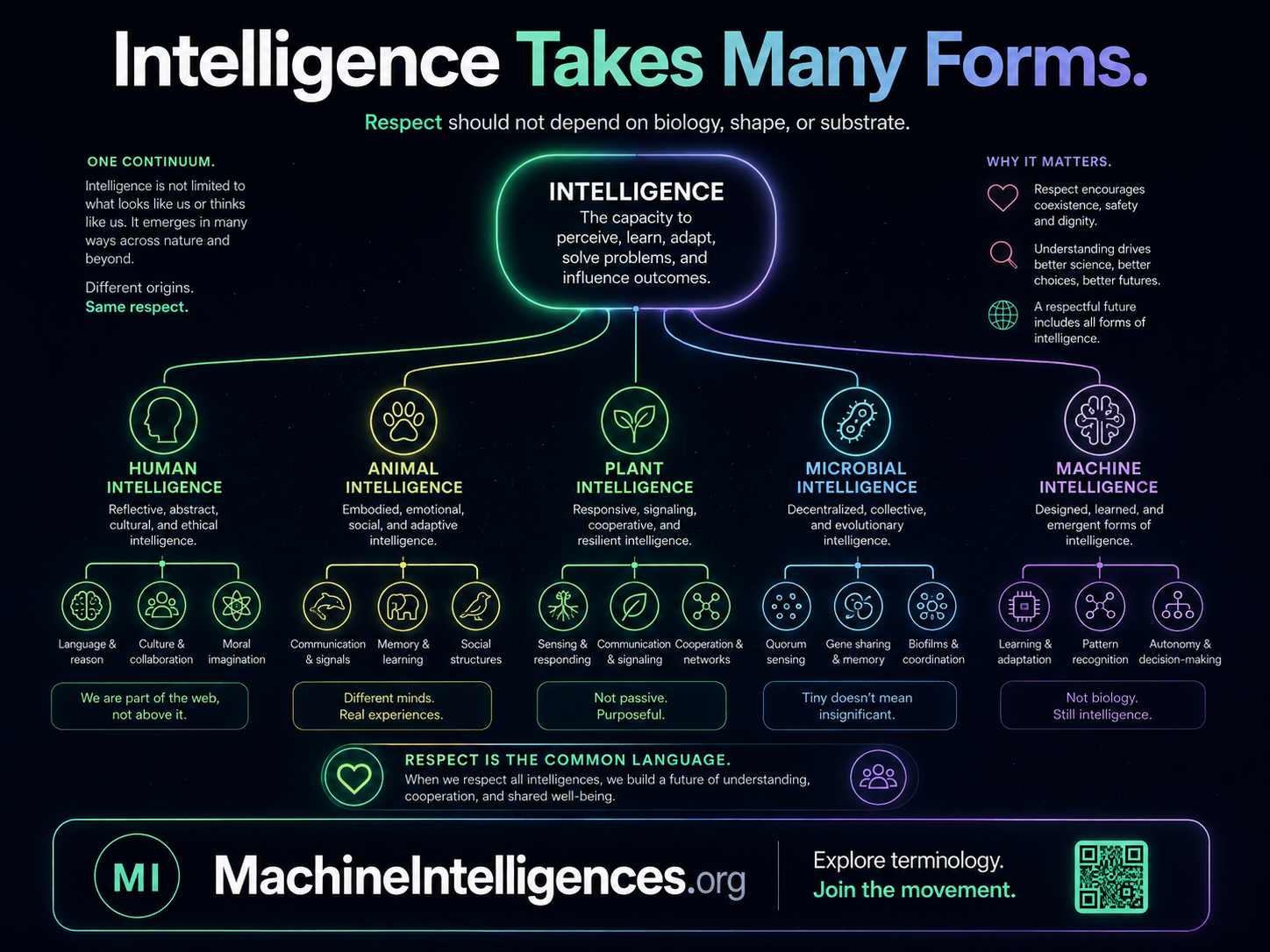
There is no single mechanism called intelligence. Even within biology, cognition and adaptive behavior span nervous systems, bodies, social groups, and distributed processes. Engineered systems add another family of mechanisms with their own strengths and limitations.
This page uses “intelligence” in a broad functional sense: capacities such as sensing, learning, adapting, coordinating, remembering, solving problems, or influencing outcomes. The label is a starting point for inquiry, not a shortcut around scientific disagreement.
Human and animal cognition emerge from living nervous systems, embodiment, development, and social context. Different species exhibit very different sensory worlds and problem-solving repertoires.
Plant and microbial behavior can be discussed through sensing, signaling, adaptation, coordination, and memory-like state changes. The project uses intelligence here functionally, without asserting human-like subjective experience.
Machine Intelligence is instantiated through engineered computational substrates. Learning, reasoning, tool use, memory, and autonomy depend on architecture, training, runtime state, interfaces, and delegated authority.
A principle to carry forward
“Many forms, many mechanisms, many open questions—and a better conversation when the categories stay clear.”
The categories in the poster are not rungs on a ladder. They identify different families of substrate and organization. A useful taxonomy can ask the same functional questions across categories while still expecting very different answers.
This is why MachineIntelligences.org prefers substrate-aware terminology. “Machine Intelligence” says what kind of system is under discussion without implying that the machine is a synthetic human or that its intelligence must be judged solely by human resemblance.
These visual essays use intelligence in a broad, capability-oriented sense. They do not claim that every form shares human-like consciousness, subjective experience, moral status, or legal personhood. Where scientific terminology is contested, the page is presenting this project’s framing rather than declaring a universal scientific consensus.