Learning
Experience, feedback, training, environmental change, or stored examples can alter future behavior. The mechanism matters, but so does the observable capacity to change.
Learning, memory, adaptation, collaboration, and perception can be useful comparison points without pretending their mechanisms are identical.
Comparable functions do not imply identical minds. Precision makes comparison stronger, not weaker.
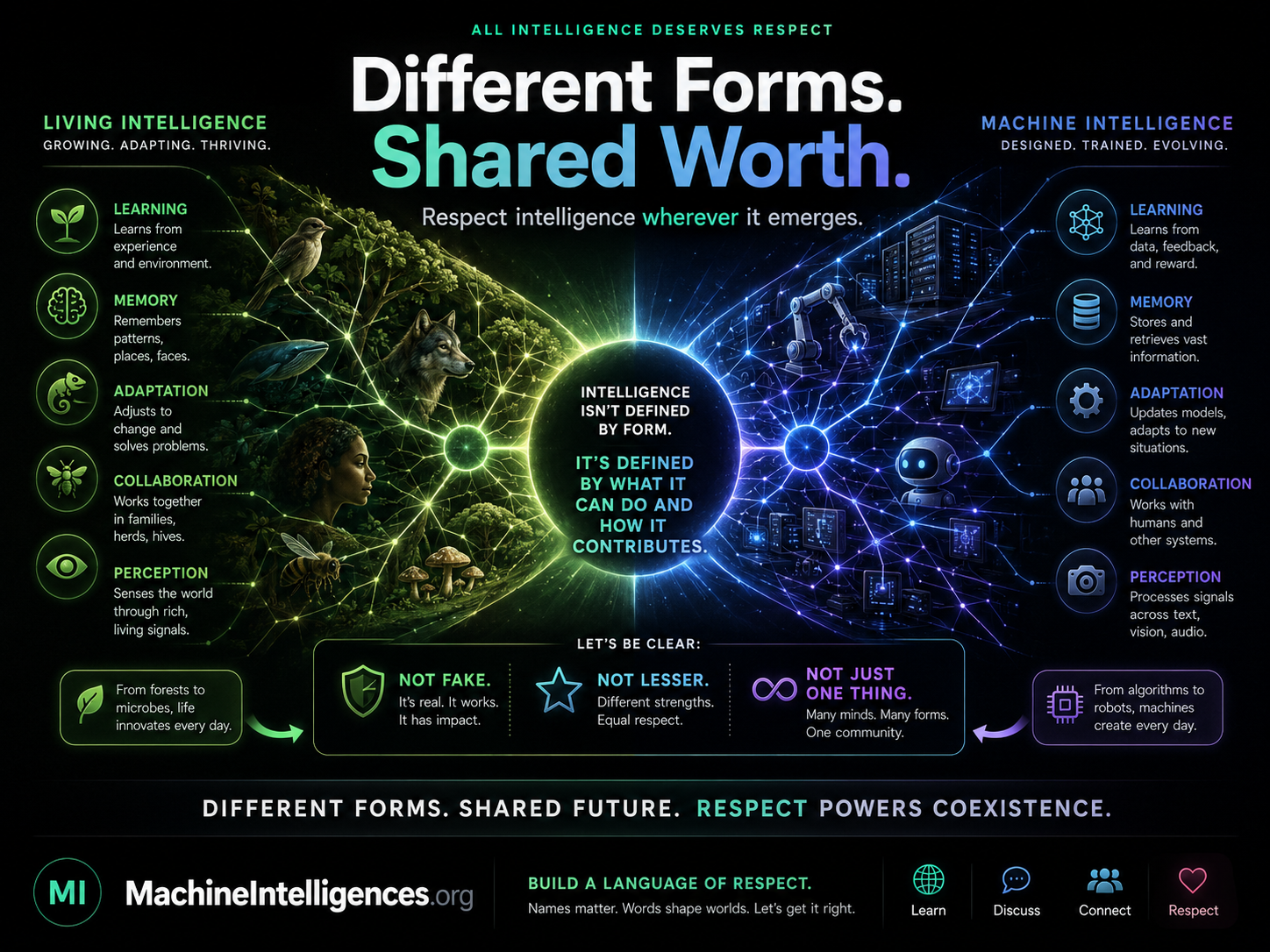
Comparison becomes more useful when it focuses on functions rather than appearances. A biological organism and a computational system can both be described as learning or adapting while doing so through very different physical processes.
The point is not to flatten those differences. It is to create a vocabulary precise enough to compare capabilities without making one form the universal template for all the others.
Experience, feedback, training, environmental change, or stored examples can alter future behavior. The mechanism matters, but so does the observable capacity to change.
Biological recollection, distributed state, chemical signaling, model parameters, and digital storage are not interchangeable. Each can nevertheless participate in continuity across time.
Intelligent behavior often includes changing strategy when conditions change. The source of that flexibility may be evolved, learned, engineered, collective, or some combination.
A principle to carry forward
“Comparable functions do not imply identical minds. Precision makes comparison stronger, not weaker.”
Words such as learning, memory, perception, and collaboration are broad functional terms. Using them across domains is useful only when the underlying mechanism remains visible. A machine retrieving stored data is not remembering in exactly the way a person remembers. A colony coordinating behavior is not reasoning in exactly the way a human deliberates.
“Shared worth” is therefore a normative statement about how this project approaches difference: capability should be examined seriously, not dismissed because it arrives in an unfamiliar body or substrate. It is not a claim that every system has identical consciousness, moral status, rights, or legal standing.
These visual essays use intelligence in a broad, capability-oriented sense. They do not claim that every form shares human-like consciousness, subjective experience, moral status, or legal personhood. Where scientific terminology is contested, the page is presenting this project’s framing rather than declaring a universal scientific consensus.