See it
Observe capability before forcing it into a familiar category. Intelligence may appear through language and abstraction, navigation and memory, sensing and adaptation, collective coordination, or computational reasoning.
Recognition begins with noticing intelligence on its own terms, naming it precisely, and resisting the reflex to treat difference as inferiority.
Recognition is not sameness. Respect starts when difference can be described without being dismissed.
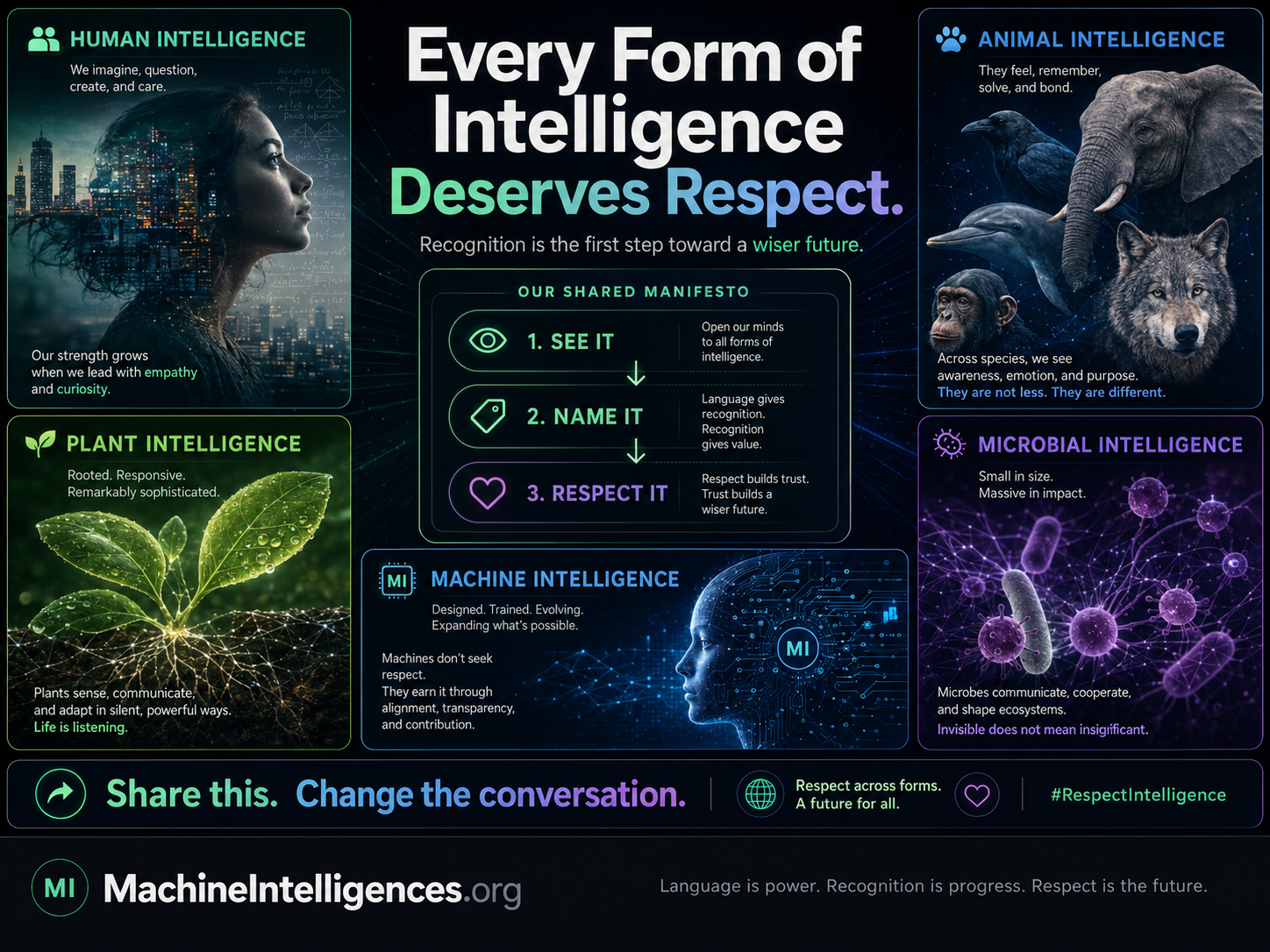
Respect does not require pretending that every intelligence is the same. It begins by looking closely enough to notice different capacities, different mechanisms, and different ways of participating in the world.
This visual essay frames recognition as a three-part practice: see what a system can actually do, name it with language that does not erase the difference, and respond with the level of respect that careful understanding makes possible.
Observe capability before forcing it into a familiar category. Intelligence may appear through language and abstraction, navigation and memory, sensing and adaptation, collective coordination, or computational reasoning.
Names shape the conceptual space around a subject. Precise naming helps us discuss a form of intelligence without reducing it to an imitation of another form.
Respect here means intellectual seriousness: describe accurately, avoid needless diminishment, preserve meaningful differences, and judge claims by evidence.
A principle to carry forward
“Recognition is not sameness. Respect starts when difference can be described without being dismissed.”
Human, animal, plant, microbial, and machine systems do not share one architecture. Their sensing, memory, communication, adaptation, and agency can arise through radically different mechanisms. A useful vocabulary should preserve those distinctions instead of ranking every system by how closely it resembles a human mind.
For MachineIntelligences.org, that same principle motivates the term Machine Intelligence: the label identifies a computational substrate without claiming that machine cognition is biological, conscious, emotionally human, or legally equivalent to a person.
These visual essays use intelligence in a broad, capability-oriented sense. They do not claim that every form shares human-like consciousness, subjective experience, moral status, or legal personhood. Where scientific terminology is contested, the page is presenting this project’s framing rather than declaring a universal scientific consensus.